Wednesday, 26 August 2020

Celtiberian Bronze Horseman

This metalwork image was popular in Celtic times because you see it now in various museums.  There is something about the image that means I have to do some work with it.  Considering they didn’t have paper back then to fiddle with design, my guess is they used clay to plan it all out.  It would be good to build up the image with card or something to bring it forward.


I played with the photocopy to bring out detail that was virtually lost.  The object is solid and the outline shows this.  I can see what I want at the end of this in my head, but I can’t put it into words  yet.  I like it as it is, which fills me with a sense of duty, because I want to resurrect its glory, not diminish it.  Verdigris is a whole new bag and although this piece is basically jewellery, I don’t think I’m going down the bling road, but the archaeologists route instead.

Ok, so let’s say I found it at the bottom of a path during a long hike in Cornwall, where I was lost and really tired with no water and sore feet.  Then I see it before me, just to the side of where I am about to take my next step, covered in dirt, lost and unloved.  I pick it up, it looks rusty but really really old.  I decide there and then that before I hand it into the authorities, I must take it home and draw it.  I can see it might have been gold, but gold doesn’t rust, so it has to be bronze.  I see there are large jump rings on it, so this means it was hung on something...etc etc.

I digress...
For classical iconography of creatures that fed into visual culture, you’re basically looking at anything that was around in the Ice Age.  We have to face up to the fact that before we figured out how to ride them, to Ice Age cavemen, women and children, a horse was food.

The other thing to note about Ice Age creatures is our modern day preoccupation with elephants that clearly comes down to us from our relentless pursuance of Wooly Mammoths.  Entire migratory routes follow the Wooly Mammoth.  A mammoth represented a lot of food for a community.  You see hundreds of representations of mammoth carved into rocks and bones.  To dream of catching a mammoth, to hope and pray...

The thing I’m really stuck on though is dragons.  All depictions of dragons faithfully record scales, so the original terrifying beast must have been a serpent of some sort and also must have lived in either a cave or in the water that bore holes into the cave.

There is a giant Mesolithic snake that could have been the source of the original ‘dreaded dragon encounter’ methinks, but the fossil record shows it died out before Neolithic times.  My view is, because it was so big and scary and you had no chance of defeating it with rocks back then, as a continual source of fear it persisted in the psyche of descendants of very early man.  Virtually all cultures have a dragon and that’s fascinating too, because so far they’ve only found fossils in Columbia of this big snake monster thing.

But saying that, the famous Irish Elk, which is another massive creature from cave man Ice Age days was actually a native of a huge expanse of the northern hemisphere, not just Ireland. So we have to take care with the names of these finds, so as not to restrict our understanding of their prevalence in the culture.  In my view, Scythian stag representation harks back to the giant Ice Age Irish Elk, but that’s only my own opinion from staring at so many luscious Scythian gold artefacts.

Friday, 21 August 2020

Ashmolean visit

I went to the Ashmolean Museum a while ago.  I really like that museum but it’s now first among equals with Wiltshire Museum and Salisbury Museum.


Here are some of the pictures I took...


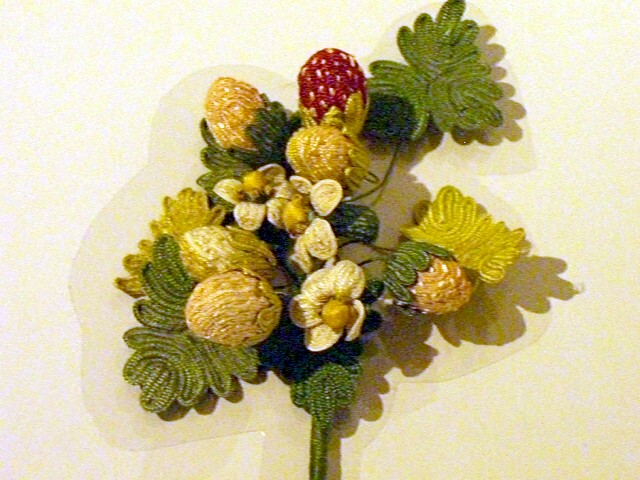
Looking at this very cute posy.  I was intrigued as to how they made it and how quickly it might be made.  Now it just so happens that in the Sweet Bags book, it explains how to do it.  In fact there are lots of examples of miniature textile fruit decorating the base of  historic sweet bags and they are usually composed in sets of three.

The posy is very small and designed as a textile brooch.  I adore textile brooches but never wear them myself as they can be so hopelessly sentimental, they give away far too much about the wearer.  This first example is particularly fine.

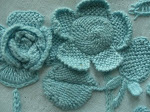
This next example above isn’t quite so polished but very sweet all the same. Again, it’s tiny.

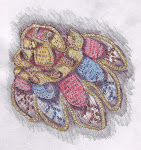
Next is the picture of the museum catalogue entry.
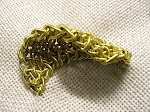
Lastly is this little flower.

* In my hunt for zoomorphic gold designs I’ve reached Pannonian Avars art, 55AD which looks more Celtic as a style than Alemanni but the really interesting thing about pagan iconography is shared Gods, not only between major tribes, but between ‘Barbarian’ tribes and early Romans.  I don’t think it’s enough to just admire these images, I need to somehow own them.

For things that I’ll never touch or even see in 3-d, some objects are so incredibly striking you just really want to get under their skin, somehow.  There is something so powerful about early patterns and designs, especially of animals and human figures that resonate even now.  In fact, simple designs have to be more perfect than grandiose statements, because every part of them will be scrutinised.

I have a lot of art materials lying around and to my mind, needlework work bridges a gap between 2-d and 3-d that nothing else’s does.  I suppose Picasso’s sculpture made of found objects is an exception.  It’s been my intention for ages to make repro archaeological finds. There, I’ve said it out loud, which is scary in itself.  Time is swallowing us all up.  What is time to a mountain?  What is time to a leaf or butterfly?


Tuesday, 18 August 2020

Update on stasis...

Ok, so because we still have progeny camping in our living room and consequently, I can’t find my stuff - you know how it is - I decided to dye my hair.

I think I’d managed about half my head, when a piece of errant hair decided to go AWOL and firmly deposit itself into my eye in a demonic thrashing motion.

So afterwards as a way to expunge the experience, I did this quick cartoon of how it felt in that moment of sudden agony, when the catastrophic vision flashed before me, where I maybe had to drive myself to A&E with the use of only one eye, during a pandemic virus Thing, with wet,  and horror of horrors, only half-dyed hair!

Well, I’m pleased to say the eye ball recovered but the hair is another matter....


Monday, 17 August 2020

Top section mermaid design decision

Update 17/08/20


Sun, sky, border and stitches have been decided. The two triangle templates will be sewn as separate slips in gold.  Not sure what colour couching thread yet, but that won’t take a long time to decide.

I decided I need to come forward now and bring the border out in relief. The highest surface point will be the border, then everything goes back into the image. My only concern is the rays of the sun will have two planes to transverse, so they will need to be added slips too that taper down with direct sewing, or bordered cord...?

I’m still leaving the face alone, because even though the eye is too heavy, it might not be at the end, when balanced against heavier elements e.g. the sun, fish scales and a pearl necklace and bracelet.  We’ll see.

P.S. It’s brightening up again now and the tiny birds are back at last.  I’ve surmounted my backlog in the day job and been reading about the Scythian culture from The Steppes. There was an exhibition about three years ago about this Russian tribe but I missed it.  It doesn’t matter too much, because there is a ton of stuff around now about them, as Russia has opened up.  I’m particularly interested in the Scythian zoomorphic art in gold.  They lived in Russia but were originally Iranian.  They were marshals of the Silk Road and invented these really powerful bows that contained sinew.
Scythian Art

Saturday, 15 August 2020

Lady with Falcon

This little face was done a while back immediately after I had studied ‘back split chain‘ phase one of my analysis.  I’m posting it again now because it shows how we only see what we can see at the time, until our brains can work out some more of the mystery at a later date.  It also follows, I find, that you  need to see a whole stack of images to be able to sift through to the grist of what you’re searching for.

Clearly now, I can tell the sewing on the face is wrong but crucially am able to understand why: the stitches do not stack up in the correct order of one row to the left, return row pointing to the right.  So because the rows did not form pairs in this way, the stitches did not stack up as I know now that they should.  I will leave the face alone however, but just re-do the forehead. because that will be do-able.

The piece is going to be made up by various slips, which will then be mounted together to form the image below, again it’s smaller than A4.  I’ve decided to work in that way because that’s what can be seen on extant pieces, especially if you look at them from the side of the display case in museums.

I was thinking quite a bit of my DD at the time of sewing this image and as a result it looks more like her than the medieval lady.  Two serious ladies with great hair...

I’m very interested in the pattern on her clothes now, I wonder how faithfully they can be reproduced.  I might try a little swatch and see how it goes.  The question is always the same: do we simplify what we see or do we use the complexity of such a pattern as a springboard for creativity?  We’ll see...


I stopped working on it back then, because I realised the folds of her drapery were going to be really (really ) hard. Now I shall tackle them with underside couching of silk thread, which I’ve seen used on period pieces very effectively to describe drapery of clothes.  It’s a great design for running away with the illusion of texture...

I’ll post some museum examples next time...

It’s finally raining in Blighty again to cool us all off after being so incredibly hot for days and nights on end.


Monday, 10 August 2020

Opus Anglicanum - repro how-to

Edited Post : Apologies!
The pictures blue-toothed in the reverse order, so I’ve rectified the situation.

Following on from
This post
Here is how I made the stitch.

Double the thread.


Bring  needle out at point A

Separate the threads, all the way to the needle’s eye


Take one or two threads, sew method, going backwards into the chain, like a back stitch.

Pull through, maintaining control all the way

Keep the threads apart using your fingers as a loom


Nearing the end...


Draw all the way through. Tension upwards, gently.

Then bring the threads down and tension downwards, according to stitch length uniformity.
Keep the threads from twisting at all times, especially at the start of a new stitch.
You can work up to a decent speed in this way.

Continue in this way until you reach 1cm
I was able to make 14 stitches.  I took one or two threads each time. If I’m working inner curves, I would halve the stitch length by tensioning upwards a little more, as I mentioned before.


I have used two layers of ground fabric.  This is the view of the back of the work

As you can see, there is nothing to see.  This corroborates my analysis from what I can see of the extant examples I have been studying,
that can be found here
in that only the first ground fabric layer of silk was stitched, as the linen underneath is not similarly pierced.

I hope to carefully stitch a reproduction face within the next 6 weeks.

* I have to cut myself some slack in my schedule as my DD has come to stay for 2 weeks.  She’s a lovely girl but tends to take over, if you know what I mean?  I will still post, but probably not every day.  I don’t know where to get tassel formers from, it looks like I shall have to use wooden eggs?  If I’m unable to post much needlework in the next couple of weeks, I’ll post drawings and history stuff.
I went to three museums that I haven’t discussed yet.  Plenty of goodies in store...


Sunday, 9 August 2020

Tassel former 4

Great Yarmouth was a very long drive in the intense heat but a worthwhile trip, some very nice architecture, very long wide beach.

OK, so here’s a video on Soumak and it will help you a lot to understand how to do stitch 2 that we were discussing.

Soumak Turkish Carpet Weaving


If you ask me, I think this Right Side Stitch is true Soumak, whereas Left side stitch is true twinning. How fascinating that they combined the two to decorate spherical forms.

Ok, so let’s dive in there....

Pull your fixed point brown thread taut, then with you worker thread come out in front, hook it over the top and pull it through to the RIGHT.  To achieve the ‘pulling through’ you need to reach in and grab it, or poke it through, whichever is more comfortable but my suggestion is find a way that works for you and reduces fiddling.  What you are aiming for is ease of movement and eventually a bit of speed.

A.


B.
C.


There you have it.

D.
As you can see in the link below.

RCT Bag: Gorgeous Bag 2

From these two basic stitches you can create shapes like the diagram you can see at the bottom of the sheet I’ve included and called D.

Another thing to note is that when they added new threads, using Larks Head Knot aka Rya knot, it creates an area of weaker tension, or put it another way, a desirable gap in the work, which they would either exaggerate or conceal.  I think that’s a very exciting concept.

Now you could say ‘oh well, you know that bag is the culmination of centuries of skilled work and rather like knitting, where you also only have two stitches, a knit and a purl, look at the endless possibilities in that craft etc?  I’d say yes, but if you could knit a sock or weave a bunch of flowers, which would you do first?

Exactly, where there’s a will there’s a way.  Or should we just let the bag rot and forget humans could ever make those things, and just sit around eating dehydrated food waiting until a space ship takes us to a new planet?

Precisely dear friends: we have a duty to rescue, collect and enrich our culture with knowledge from the past.

Have a good evening!

* I’ll come back to this RCT bag, after the Mermaid etc and I think the next step would be to draw the design carefully and try out a few motifs.  I think they made it like a giant Easter egg, then cut it in half.

I’m researching Alms Bags at the moment, in a very casual way,  nothing too involved,  but the oldest bag I found is French 1100....can you imagine!  I plan to map that one out too.  I figured if I draw it really carefully someone else might want to sew it.