Well it turns out there is only one of a kind, and it’s at The British Museum. Naturally, it has bullet-proof provenance as you would expect with BM acquisitions, because there resides a very stiff panel of experts that can really decipher what they’re looking at. See ‘Bolton Forger‘.
Breganza Brooch
Thankfully there are a ton of images out there of this particular fibula and it’s been exhibited many times prior to its present location.
It’s even been copied by a jewellery workshop in Toledo, who then wrote a book about how they did it.
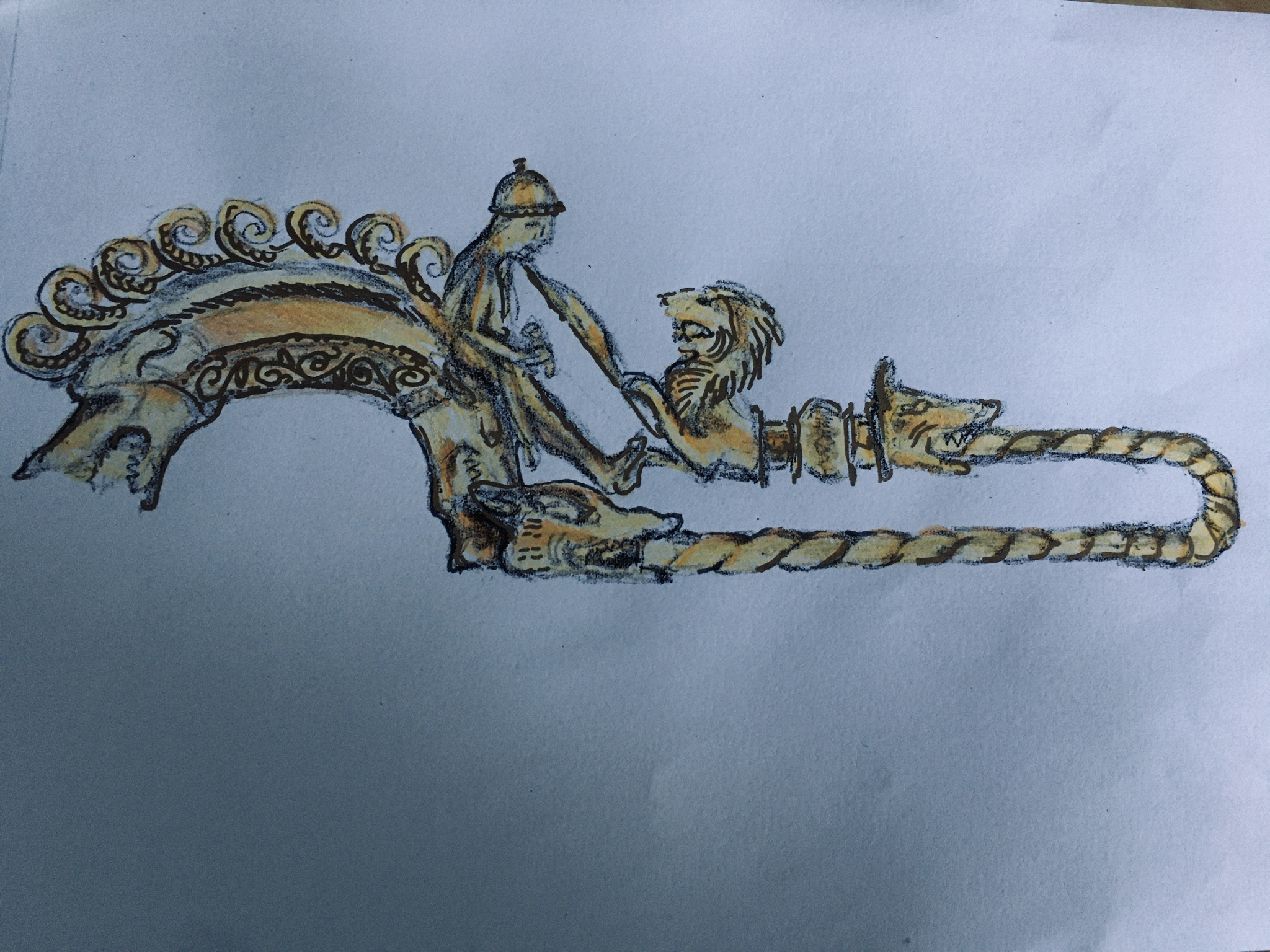
I think the copy they crafted is good, the colour’s wrong, but overall it’s good. I don’t like the warrior’s face though, so, back to basics.
Here are three versions of what I’m dealing with here, see below. As usual the first one is probably best, the rest get progressively more heavy handed. What was I doing with that gold Sharpie? Since then I found more of my materials.
Aside from that, I think I retained the essential drama of the piece.
Now I find however, that I’m not entirely sure how I feel about the viewpoint of the piece from what I know now about it’s history.
“Hellenistic craftsman commissioned by an Iberian client“ (methinks warlord) who was possibly (methinks probably) not himself Celtic? Then owned much later by the House of Breganza for many years.
The House of Breganza I believe and have no problem with, especially as the Celtic region in Spain stretched across to what is now Portugal.
What I’m a little uncomfortable with is, that in my view, it was made to impress non Celtic people, and worn by a non Celtic person. You have to ask yourself why? Think about it, why would this high ranking person commission a Greek goldsmith, why not remain within ‘the tribe‘? IMO it was because he was advertising his potential strength in battle.
But at least it’s a detailed description of a very successful and proud Celtic warrior. I mean he’s looking at the huge dog as if it were a Yorkshire Terrier, in fact if you think about the story the piece tells, it looks like all the dogs were probably his. Dogs used in battle were very typical in ancient times and still are. (I think the later Roman battle dog was particularly frightening, if you ask me.)
The Celts were famous for breeding battle dogs and I believe in Ireland the Celts had a high reputation for that.
Looks to me that by the time this piece was made, the Celtiberians were mercenaries who were losing most of their territory but were trying to adapt (survive).
Always great miners, warriors, craftsmen and lovers of gold. Notice how there is always a Celtic community living near a gold mine, in fact, much later, by the time the Romans reached France, they discovered the Celts actually had many secret gold mines. In England there were and still are, active gold mines in Cornwall and Wales. English gold tends to be subtlety more pink, whereas Iberian gold tended to be a very warm yellow. The Sky Disc of Nebra contains Cornish gold.
I think gold mining in Spain ended around 1500, or possibly earlier, but before that, they had a lot of gold and it was truly luscious.
Gold Mining in Iberia
The amazing gold torcs of the Celtiberians have been unearthed around Stone Henge a heap of times. You’ve only to go to the Salisbury and Ashmolean museums to see them.
The Celtic world had very strong links and their oral history must have been amazing., hence why we all love a good story.
Also let’s not forget, much later, the legend of Tristan and Isolde, he was supposed to have been Iberian, that one could say “came over here and got a job” quite easily, kind of thing.
Anyway, now back to these foundation drawings...
There are finally 8 swirls of hair, but there is a mistake at the bottom of the composition. In better photos I can see it’s solder, but for this drawing I didn’t have that information and so um, fudged it.
I think the part of this design that makes my eyes bulge most is the ‘filigree’ around the inner curve of the ‘dragon’s’ neck. It’s not a dragon per se, it’s a dog or semi wolf, but in my view, it has to have been an influence in the dragon motif evolution blah.
So I’ll do a blow up of the section of ‘filigree’ and show you a very interesting design detail.
Gotta go ppl, but before I do, here’s my rendition of Isolde....I wish....hahaha,
Showing posts with label Celtiberian. Show all posts
Tuesday, 15 September 2020
Wednesday, 26 August 2020
Celtiberian Bronze Horseman
This metalwork image was popular in Celtic times because you see it now in various museums. There is something about the image that means I have to do some work with it. Considering they didn’t have paper back then to fiddle with design, my guess is they used clay to plan it all out. It would be good to build up the image with card or something to bring it forward.
I played with the photocopy to bring out detail that was virtually lost. The object is solid and the outline shows this. I can see what I want at the end of this in my head, but I can’t put it into words yet. I like it as it is, which fills me with a sense of duty, because I want to resurrect its glory, not diminish it. Verdigris is a whole new bag and although this piece is basically jewellery, I don’t think I’m going down the bling road, but the archaeologists route instead.
Ok, so let’s say I found it at the bottom of a path during a long hike in Cornwall, where I was lost and really tired with no water and sore feet. Then I see it before me, just to the side of where I am about to take my next step, covered in dirt, lost and unloved. I pick it up, it looks rusty but really really old. I decide there and then that before I hand it into the authorities, I must take it home and draw it. I can see it might have been gold, but gold doesn’t rust, so it has to be bronze. I see there are large jump rings on it, so this means it was hung on something...etc etc.
I digress...
For classical iconography of creatures that fed into visual culture, you’re basically looking at anything that was around in the Ice Age. We have to face up to the fact that before we figured out how to ride them, to Ice Age cavemen, women and children, a horse was food.
The other thing to note about Ice Age creatures is our modern day preoccupation with elephants that clearly comes down to us from our relentless pursuance of Wooly Mammoths. Entire migratory routes follow the Wooly Mammoth. A mammoth represented a lot of food for a community. You see hundreds of representations of mammoth carved into rocks and bones. To dream of catching a mammoth, to hope and pray...
The thing I’m really stuck on though is dragons. All depictions of dragons faithfully record scales, so the original terrifying beast must have been a serpent of some sort and also must have lived in either a cave or in the water that bore holes into the cave.
There is a giant Mesolithic snake that could have been the source of the original ‘dreaded dragon encounter’ methinks, but the fossil record shows it died out before Neolithic times. My view is, because it was so big and scary and you had no chance of defeating it with rocks back then, as a continual source of fear it persisted in the psyche of descendants of very early man. Virtually all cultures have a dragon and that’s fascinating too, because so far they’ve only found fossils in Columbia of this big snake monster thing.
But saying that, the famous Irish Elk, which is another massive creature from cave man Ice Age days was actually a native of a huge expanse of the northern hemisphere, not just Ireland. So we have to take care with the names of these finds, so as not to restrict our understanding of their prevalence in the culture. In my view, Scythian stag representation harks back to the giant Ice Age Irish Elk, but that’s only my own opinion from staring at so many luscious Scythian gold artefacts.
I played with the photocopy to bring out detail that was virtually lost. The object is solid and the outline shows this. I can see what I want at the end of this in my head, but I can’t put it into words yet. I like it as it is, which fills me with a sense of duty, because I want to resurrect its glory, not diminish it. Verdigris is a whole new bag and although this piece is basically jewellery, I don’t think I’m going down the bling road, but the archaeologists route instead.
Ok, so let’s say I found it at the bottom of a path during a long hike in Cornwall, where I was lost and really tired with no water and sore feet. Then I see it before me, just to the side of where I am about to take my next step, covered in dirt, lost and unloved. I pick it up, it looks rusty but really really old. I decide there and then that before I hand it into the authorities, I must take it home and draw it. I can see it might have been gold, but gold doesn’t rust, so it has to be bronze. I see there are large jump rings on it, so this means it was hung on something...etc etc.
I digress...
For classical iconography of creatures that fed into visual culture, you’re basically looking at anything that was around in the Ice Age. We have to face up to the fact that before we figured out how to ride them, to Ice Age cavemen, women and children, a horse was food.
The other thing to note about Ice Age creatures is our modern day preoccupation with elephants that clearly comes down to us from our relentless pursuance of Wooly Mammoths. Entire migratory routes follow the Wooly Mammoth. A mammoth represented a lot of food for a community. You see hundreds of representations of mammoth carved into rocks and bones. To dream of catching a mammoth, to hope and pray...
The thing I’m really stuck on though is dragons. All depictions of dragons faithfully record scales, so the original terrifying beast must have been a serpent of some sort and also must have lived in either a cave or in the water that bore holes into the cave.
There is a giant Mesolithic snake that could have been the source of the original ‘dreaded dragon encounter’ methinks, but the fossil record shows it died out before Neolithic times. My view is, because it was so big and scary and you had no chance of defeating it with rocks back then, as a continual source of fear it persisted in the psyche of descendants of very early man. Virtually all cultures have a dragon and that’s fascinating too, because so far they’ve only found fossils in Columbia of this big snake monster thing.
But saying that, the famous Irish Elk, which is another massive creature from cave man Ice Age days was actually a native of a huge expanse of the northern hemisphere, not just Ireland. So we have to take care with the names of these finds, so as not to restrict our understanding of their prevalence in the culture. In my view, Scythian stag representation harks back to the giant Ice Age Irish Elk, but that’s only my own opinion from staring at so many luscious Scythian gold artefacts.
Subscribe to:
Posts (Atom)